Business Flexibility and Business Resilience
Introduction
I’m a part-time researcher and thought leader on the subjects of business flexibility (BFL) and business resilience (BR). In my spare time, I’ve been studying both since 2018.
I’ve come to believe both BFL and BR are in their infancy, in terms of how they can help organisations solve a range of problems. I’ve discovered that business flexibility is fundamentally about scaling, capability and risk management. While business resilience is more about risk management. resource usage and resource life.
Definitions
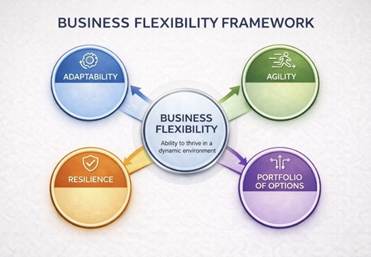
My working definition of business flexibility (BFL) is that it has 4 components: adaptability, agility, resilience and portfolio of options. We’ll unpack them shortly.
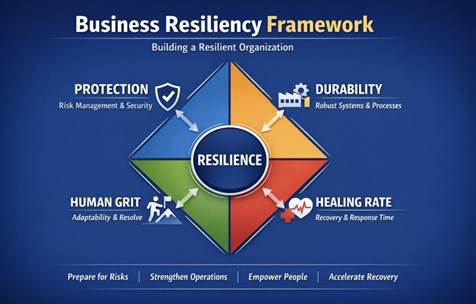
In turn, my working definition of business resilience (BR) is that it also has 4 parts; protection, durability, (human) grit and healing rate.
Universal Equations
Since to my knowledge, there are no universal equations yet developed for BFL and BR, we can assume more of any combination of the inputs (the components) leads to bigger outputs – greater BFL, or greater BR. As with the introduction of the internet in a work setting, hybrid working, or AI investment, a prudent approach is to monitor progress (via system analytics) and refine the measures as you go.
Trade Offs
Businesses routinely struggle with an inherent trade-off between business efficiency and business flexibility. Efficiency gains are fantastic in the short term. But do little to handle the next black swan event, or industry disruption.
A second trade-off comes in considering value creation versus business flexibility creation. However, clever planning means no trade-off is actually necessary. When BFL is communicated well, investors pay a premium on companies that credibly display it. Think of the PE ratio for Apple or Microsoft, in no small way based on the versatility and popularity of their products, coupled with their vast R&D reserves.
Is there a trade-off between strategic focus and BFL? I would argue that you can achieve both. First decide the focus and then seek to maximise BFL within that scope.
Resilience, Sustainability and Investor Demand
To build trust and confidence in the investor community, first improve ESG initiatives in authentic ways. However, to improve ESG initiatives, first improve BFL. Climate resilience is similar to business resilience, with similar components of protection, durability and healing rate.
Risk Management
Business flexibility is a hedge against environmental uncertainty. Therefore, in my view, BFL deserves some consideration and some investment. I’m not convinced enough boards realise the hedging benefit of BFL. Or that enough boards have business flexibility champions sitting on them.
Time Constraints
Let’s say you encounter a fast-moving threat. If there isn’t much time to adapt your organisation (evolve), or build business resilience quickly, you want to be able to turn to your portfolio of options and deploy agility instead. Other time-flexibility tactics are to buy more time, or play for time. Some businesses even reinvent time as a further form of time flexibility. Think reverse mentoring, nostalgia products or blurring the boundaries between customer delivery stages as examples.
Plan and Option Flexibility
There’s a useful distinction to be drawn between plan flexibility (several, alternative big plans) versus option flexibility (multiple ways to achieve one plan). Both have their place.
Style and Substance Flexibility
In your product and service design, think explicitly about creating both style and substance flexibility for your intended customers. An example of style flexibility are the different human blood groups. They don’t affect the substance of how the human body functions. Content available in multiple languages, customisable game characters and product colours are another examples. Examples of substance flexibility are; smartphones, Swiss Army knives and even the humble Excel spreadsheet.
BFL Unpacked
Let’s unpack BFL further and also consider some measures. Adaptability is essentially the rate of evolution of your organisation. A word to the wise – your board should be obsessed with this.
With biological evolution, two important measures are the rates of extinction and the rates of new population growth. In a business context, the extinction rate might be about how fast you can decommission legacy technologies. For example, a car plant swapping out its fossil fuel engine plant for electric vehicle plant instead. A nuclear power station or military fleet being decommissioned. Or a high street bank shutting down its physical branches.
AI investment and digital simulations may accelerate the R&D rate to create new products and services. Note that adaptation is more about rate of IP development, than time to market.
Agility flexibility considers both pace (can leapfrogging be used?) and direction of travel via pivoting. Measures include acceleration, deceleration, average velocity, peak velocity and direction of travel. A separate and helpful additional set of measures cover what can you see ahead and behind – driver vision, warning signs, vehicle sensors and satnav or radar all provide complimentary insights.
Measures for a portfolio of options include; volume, value and the relative power of each option (relative to a black swan event). Options include both real and financial options. Options value is related to time to maturity and level of environmental uncertainty. The options may or may not be valued on the balance sheet. Unrestricted cash reserves are an example of an option valued on the balance sheet. The ‘goodwill bank’ is an example of an option not valued on the Balance Sheet. Consider managing a portfolio of options the same way that an investment portfolio manager manages their portfolio (diversification. replenishment, implied or market valuations). The portfolio of options also acts as a set of latent risk mitigators.
Within business resilience, protection examples include physical and cyber security systems. Measures are about uptime and threat prevention effectiveness. Durability (wear and tear) measures include wear rates and tear rates. Grit is a very human quality and measures the determination to succeed or endure, under threatening, stressful circumstances. Measures are about uptime and threat prevention effectiveness. Perhaps Antipodeans with their inbuilt pioneering mindset have a edge in the grit department? Finally, Healing rate is about target and actual recovery rates to achieve either minimum standard, or original standards of activity. Following a black swan event, if a business can resume its gameplan very quickly, that’s a good return on its historical resilience investment.
Car industry case study of BFL
Car manufacturers have demonstrated adaptability in several ways – converting F1 design performance into family car functionality and moving from internal combustion engine to electric engine technology.
Car manufacturers have shown agility in matching competitor offerings across multiple vehicle markets, retooling factories and automating assembly processes, as required.
Car manufacturers have shown resilience to export restrictions and tariffs, currency fluctuations and supply chain shortages alike. During periods of government lockdown (Covid) they had to endure reduced sales and production activity, while funding fixed costs.
Finally, car manufacturers developed their own portfolios of options, building up cash reserves in multiple currencies, controlling the release of product innovations, investing in staff multi-skilling and building up customer information globally.
Mechanisms that generate BFL themselves
BFL is a bit like human fitness – invisible and prone to dissipating without active replenishment.
Once you become a true believer in the business value of BFL, an inevitable next step is to delve more deeply into the subject. And search for mechanisms that automatically code for business flexibility in your organisation i.e. generate and replace business flexibility as it becomes spent.
During my research journey, I’ve identified around 40 such mechanisms. Some are business-hygiene level, some are business-culture related and others are more strategic in nature.
Matrix management and networks are two examples of BFL mechanisms operating at the business-hygiene level. Mass customisation products and contract clauses design-in future flexibility, in a more strategic way. Two cultural mechanisms to generate or preserve ongoing flexibility are explicit staff incentives for flexibility and having a board of directors evenly split between business flexibility advocates and growth (or efficiency) advocates.
In a business consulting capacity, I’m open to helping organisations systematically work thru potential practical and relatively low-cost approaches to improve their own BFL. My contact details are on Linked In.
Summary
Both BFL and BR deserve serious consideration in your business model as a means to gain competitive advantage, manage risk and remain economically viable, regardless of environmental conditions. What do you have to lose?
Simon